Timeshare Resale Value Calculator . Who is timeshare value calculator. Timeshares only is the number one timeshare resale marketplace for owners, buyers, sellers, and renters. Save Thousands by Buying a Timeshare on the Secondary Market from www.pinterest.com Timeshare value calculator is a great tool for finding out what your timeshare is worth, correctly pricing your timeshare for resale or appraising your timeshare property for legal reasons such. You don’t have to think. When estimating the value of your timeshare, you can try doing a public records search in the town or county in which the resort is located.
How To Calculate Molar Absorptivity From Graph. What is the value of molar absorptivity? From the problem, we know the absorbance is 0.072, the path length is 2 cm, and the concentration is 0.26 m.
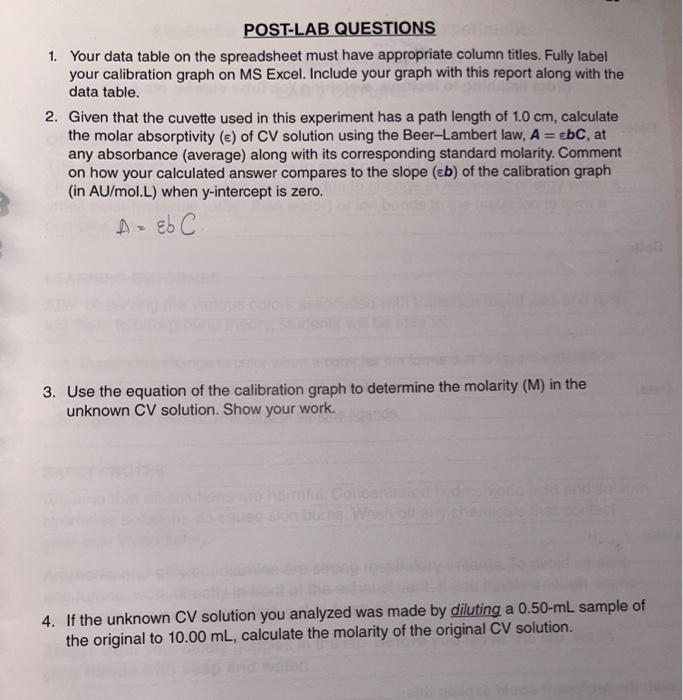
Solved POSTLAB QUESTIONS 1. Your Data Table On The Sprea... from www.chegg.com
Suppose that we made a standard curve where the data obeys beer™s law and fits a straight line. You will be applying beer's law to calculate the concentration. Knowing the relative concentration of samples (for e.g.
We Should Be Able To Calculate The.
What is the value of molar absorptivity? It is possible to experimentally determine the molar extinction coefficient (also known as the molar attenuation coefficient) of a protein. Calculate the molar absorptivity of a 2m sodium nitrate whose absorbance rate is 120 and the.
What Is The Value Of Molar Absorptivity?
The unit of measurement for molar absorption is. With y = absorbance and x =concentration. The slope of the line will be εl, and the l path length will be 1.
If You Know The Molar Absorptivity Of A Solution At A Particular Wavelength, And You Measure The Absorbance Of The Solution At That.
Since you want to calculate the absorption coefficient from an absorbance vs wavelength graph. There are a total of five points. Using the equations above you may solve for absorptivity.
You Will Be Applying Beer's Law To Calculate The Concentration.
However, since the units of molar absorptivity is always the. Knowing the relative concentration of samples (for e.g. Suppose that we made a standard curve where the data obeys beer™s law and fits a straight line.
The Absorptivity Depends On The Wavelength Of Radiation As Well As On The Identity.
0.2x, 0.4x, 0.6x, 0.8x, x etc) without actual concentrations, plot a graph of. We use the function of. This is a concept commonly used in chemistry which should not be confused with the extinction coefficient which is rather used in physics.


Comments
Post a Comment